By WE ARE NAVIGATORS
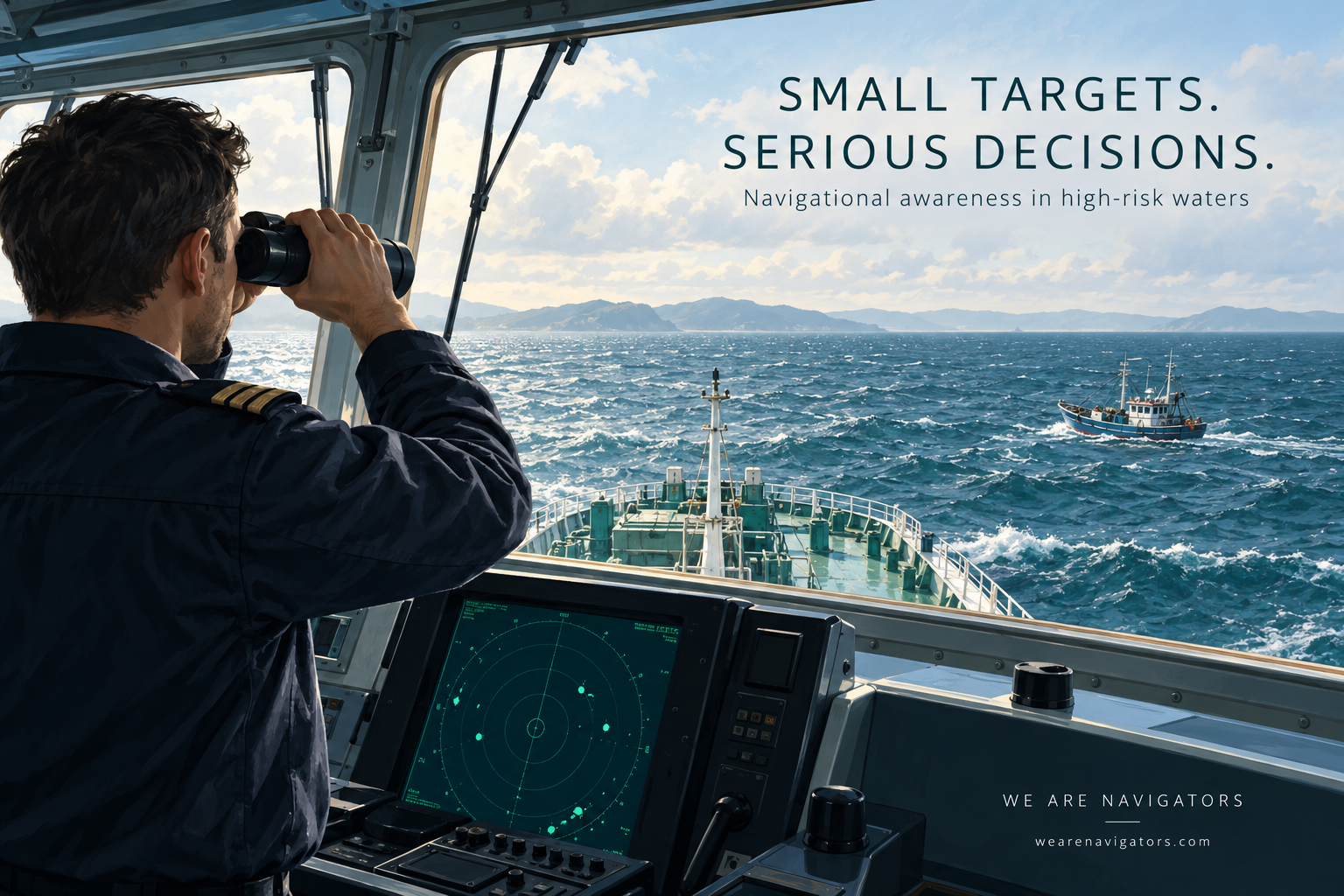
A small craft on the horizon can require a serious decision on the bridge. It may be a fishing boat, a local workboat or a vessel needing assistance. Its presence alone does not establish a security threat—but recognising it, monitoring its movement and assessing the situation matter.
In high-risk waters, bridge teams must manage security concerns alongside collision avoidance and other navigational hazards. Protecting people and maintaining safe navigation remain central to that assessment.
Security decisions need context
Messages about AIS, radar and vessel security can circulate quickly. However, an instruction intended for one vessel, location or threat scenario should not automatically become general advice for every ship.
Published industry guidance for Strait of Hormuz transits emphasises voyage-specific threat and risk assessment, with safety of life, safe navigation and environmental protection as primary considerations. The Master retains overriding authority.
BIMCO Hormuz transit guidance (May 2026)
AIS and radar also serve different functions. Decisions affecting either system require consideration of current guidance, the vessel's circumstances and the consequences for navigational awareness.
This article does not recommend switching equipment on or off. It asks a broader question: how can operators strengthen awareness of what is happening around their vessels?
Small craft can be difficult to detect
Small craft may not be readily visible from the bridge of a large ship or consistently apparent on radar. IMO's published collision lessons specifically highlight this difficulty and the importance of both visual and radar lookout.
The COLREGs require a proper lookout using sight, hearing and other available means appropriate to the circumstances. They also require careful assessment of collision risk rather than assumptions based on limited information.
IMO COLREGs — International Regulations for Preventing Collisions at Sea
For the bridge team, a detection is the beginning of an assessment. Understanding a target's movement, proximity and developing interaction with the vessel is what gives that information operational value.
Where small-target detection technology can help
Specialist small-target surveillance systems can enhance the processing of marine radar information to support detection and tracking of objects that may be difficult to distinguish on a conventional display.
Depending on the system and configuration, capabilities can include enhanced radar imaging and filtering, target tracking, alerts, camera integration and recording for later review. Applications include small-craft monitoring, security awareness and search-and-rescue support.
Small-target surveillance technical reference — Rutter STS
These capabilities can provide additional information for trained personnel. A detected target, however, does not automatically reveal its identity or intent.
Radar-based small-target detection depends on suitable radar input. It does not remove radar emissions or solve concerns about those emissions being detected. Its suitability must therefore be considered within the vessel's wider operational and security assessment.
Technology works alongside people
Enhanced detection supports the bridge team's work. It does not replace an effective lookout, collision-risk assessment or the Master's judgement.
Before selecting a solution, operators should establish the intended application, compatibility with existing equipment, expected performance in relevant conditions, installation requirements and crew training needs. Detection limits and false alerts should form part of that discussion.
The objective is useful, reliable information that helps personnel understand a developing situation and make sound decisions.
Exploring suitable solutions with WAN
Explore WAN Maritime Software & Technology services
WE ARE NAVIGATORS welcomes enquiries from shipowners, vessel managers, port operators and offshore businesses interested in small-target detection and maritime situational-awareness technology.
We can help coordinate requirements discussions and introductions to relevant specialists, with technical suitability, availability and commercial terms confirmed for each enquiry.
This article provides general awareness information. Operational decisions remain subject to applicable requirements, current official guidance and the vessel's own risk assessment.

